

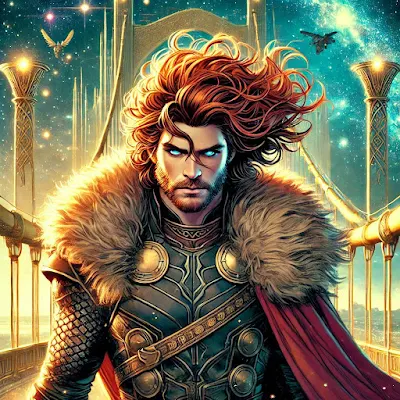
⚜️ Loki: The Trickster Who Tripped Over His Own Ego
An Enchanted Legend of Mischief, Mayhem, and the Perils of Being Too Clever for Your Own Good
The Immortal Gazette Studio ⚜️ | Legends of Norse Mythology
🐍 The God Who Could Turn Any Situation Into a Disaster
Ah, Loki.
The shape-shifter. The silver-tongued schemer. The troublemaker who could walk into a perfectly peaceful gathering of gods and somehow leave with three enemies, two broken alliances, and a rather impressive list of reasons why everything was technically someone else's fault.
In the surviving Norse myths, Loki is one of the most fascinating and unpredictable figures in the entire divine cast. He can be clever, resourceful, amusing, and occasionally helpful. He can also be deceitful, reckless, and responsible for disasters that make one wonder whether anyone in Asgard ever considered simply refusing to let him through the door.
Loki is often called the God of Mischief today, although that familiar title is a modern shorthand rather than a formal ancient Norse designation.
His mythology is considerably more complicated than a fellow who enjoys playing pranks.
Sometimes Loki helps the gods escape impossible situations. Sometimes he creates the impossible situation in the first place. And sometimes he does both, leaving everyone else to wonder whether they should thank him or throw him off a mountain.
The answer, depending on the story, might be both.
But to understand how Loki became one of Norse mythology's most notorious figures, we must begin with his origins, his extraordinary abilities, and his rather unfortunate habit of discovering that actions have consequences.
🧬 A Complicated Family Tree
Loki's parentage is not quite as straightforward as the usual description of him as half god and half giant.
In Snorri Sturluson's Prose Edda, Loki is identified as the son of Fárbauti and Laufey, also called Nál in some traditions. Fárbauti is associated with the jötnar, the powerful beings commonly translated as giants, while Loki's mother is named Laufey.
Loki belongs to a complicated mythological world in which the boundaries between gods and jötnar are far less tidy than a simple family tree might suggest.
He also has a remarkable relationship with Odin. In the poem Lokasenna, Loki refers to a bond of sworn brotherhood between himself and the All-Father.
So Loki is not merely some outsider who wandered into Asgard uninvited.
He has a place among the gods, a connection to Odin, and a history of participating in their adventures and quarrels.
Unfortunately, having a place at the table does not guarantee that anyone will enjoy your company.
Especially when you keep setting the table on fire.
🐴 The Time Loki Became a Mare
Of all Loki's adventures, few are as extraordinary as the story of Sleipnir's birth.
It begins when a mysterious builder offers to construct formidable defenses around Asgard. In exchange, he demands an enormous reward: the sun, the moon, and the goddess Freyja.
The gods agree to a bargain under strict conditions, expecting the builder to fail.
Unfortunately, the builder has a remarkable horse named Svaðilfari, whose strength allows the work to progress far faster than anyone anticipated.
Suddenly, the gods realize that their bargain might cost them considerably more than a few sleepless nights.
And who do they blame?
Loki, naturally, because he had helped persuade them to accept the arrangement in the first place.
With the deadline approaching, Loki transforms himself into a mare and lures Svaðilfari away from his work.
The builder loses the assistance of his extraordinary horse, the construction falls behind schedule, and the gods escape their disastrous bargain.
Problem solved.
Except Loki later gives birth to Sleipnir, an eight-legged horse who becomes Odin's extraordinary steed.
Yes, Loki became a mother.
Yes, the father was Svaðilfari.
And yes, the resulting horse had eight legs.
Norse mythology does not always concern itself with making things easy to explain at family gatherings.
Yet Sleipnir is no mere punchline. He becomes one of the most remarkable horses in the mythological tradition, capable of carrying Odin on extraordinary journeys.
Loki's transformation also reveals something important about his character: he is not confined by ordinary expectations, appearances, or even the usual boundaries of shape and identity.
When a problem demands an unconventional solution, Loki is often capable of producing one.
Whether anyone should let him near the family horses again is another question entirely.
🍎 The Golden Apples Incident
Now let us discuss the apples.
The gods of Norse mythology did not rely on Loki to invent immortality or persuade them to eat magical fruit. That would give him far too much credit for a situation he did not create.
The story concerns Idunn, the goddess who keeps the precious apples associated with the gods' youth.
In Snorri's Prose Edda, Loki becomes entangled in a dangerous encounter with the giant Thjazi. To secure his own release from the giant's control, Loki agrees to lure Idunn out of Asgard.
He succeeds.
Thjazi abducts Idunn, taking her away along with her apples. Without her, the gods begin to age.
Imagine being immortal, or at least accustomed to the benefits of divine youth, only to discover that the person responsible for the apples has vanished.
The atmosphere in Asgard must have been delightful.
The gods eventually realize that Loki is responsible and threaten him until he agrees to retrieve Idunn.
So Loki transforms himself into a falcon, travels to Thjazi's stronghold, turns Idunn into a nut in Snorri's account, and carries her back toward Asgard.
Thjazi pursues them in the form of an eagle.
The gods see the approaching chase and set a fire at the walls of Asgard. Thjazi flies into the flames, and the gods kill him.
Idunn returns. The gods recover their youth. And Loki, having created the crisis and then helped resolve it, escapes the immediate disaster.
Classic Loki.
To be fair, this story demonstrates both his cunning and his willingness to take considerable risks. His actions nearly bring disaster upon the gods, but his abilities also help restore what was lost.
It is less a tale of stolen immortality than a story about Idunn's apples of youth, Loki's dangerous bargain, and the consequences of his schemes.
And perhaps it offers a useful rule for divine life:
If your friend has to rescue you from a crisis that your own deception created, you might owe that friend an apology.
Loki, however, has a rather inconsistent relationship with apologies.
🌿 The Mistletoe That Changed Everything
Of all Loki's actions, none carries consequences as terrible as his involvement in the death of Baldr.
Baldr, the beloved son of Odin and Frigg, begins to experience dreams that foretell danger to his life.
The gods become alarmed.
Frigg seeks protection for her son by obtaining oaths from the things of the world, asking them not to harm him. In Snorri's account, nearly everything agrees to spare Baldr.
Fire, water, metals, stones, the earth, trees, animals, and other things are all included.
Baldr becomes seemingly invulnerable.
The gods even turn his invulnerability into a game, throwing weapons and other objects at him for amusement, knowing that nothing appears capable of hurting him.
Loki, however, is displeased.
He disguises himself as a woman and questions Frigg, discovering that she overlooked mistletoe because she considered it too young to pose a threat.
One small plant.
One overlooked exception.
One very serious mistake.
Loki obtains the mistletoe and brings it to the gathering. There he finds Höðr, Baldr's blind brother, who cannot participate in the game because he cannot see where Baldr stands.
Loki offers to guide him and provides the mistletoe.
Höðr releases it toward Baldr.
The mistletoe strikes him, and Baldr falls dead.
The gods are devastated.
This is not a harmless prank that goes spectacularly wrong. Loki deliberately exploits the weakness in Baldr's protection and enables an act that brings immense grief to the gods.
The precise question of Loki's motives is not fully explained by the surviving sources, but his role in the tragedy is unmistakable in Snorri's account.
And this is where the trickster's cleverness begins to look less like a gift and more like a terrible liability.
Loki has always been able to find the loophole.
This time, the loophole kills a god.
⚖️ The Consequences of Being Loki
Following Baldr's death, the gods seek a way to bring him back from the realm of the dead.
Hermóðr travels to Hel to plead for Baldr's return. Hel agrees on a condition: all things must weep for Baldr.
Nearly everything does.
But a figure named Þökk refuses.
The surviving account does not explicitly name Þökk as Loki, although the character is traditionally interpreted as Loki in disguise in many retellings.
Because of that refusal, Baldr remains in Hel.
The loss deepens the gods' grief, and Loki's involvement in the tragedy brings him closer to the punishment that awaits him.
Eventually, the gods hunt him down.
Loki attempts to escape by transforming himself into a salmon, but the gods capture him. In Snorri's account, they bind him using the entrails of his son Narfi, while another son, Váli, is transformed into a wolf.
The details and names vary between surviving traditions, but the punishment is unmistakably grim.
A venomous serpent is fastened above Loki, allowing its poison to drip onto his face.
His wife, Sigyn, remains beside him, holding a vessel to catch the venom. When she must empty it, the poison falls upon Loki, causing him to writhe in agony.
The violent convulsions are associated in the tradition with earthquakes.
It is a dreadful fate for a figure whose cleverness has repeatedly allowed him to escape danger.
For once, Loki cannot simply transform himself into something else, talk his way out of trouble, or devise a clever bargain.
He is bound until Ragnarök.
And the irony is difficult to ignore.
The trickster who repeatedly helped create problems for the gods has finally become the one who cannot escape his own.
🔥 Ragnarök: The Final Consequence
When Ragnarök arrives, Loki's bonds break, and he joins the forces opposing the gods.
The final battle brings together the enemies and divine figures whose destinies have been intertwined throughout the mythology.
Loki takes part in the catastrophe, and the surviving accounts describe his final confrontation with Heimdall, the vigilant guardian associated with Bifröst.
The two kill one another.
There is no clever escape waiting for Loki at the end of this conflict. His story concludes amid the destruction of the old world.
But it is important to distinguish what the myths actually establish from the more dramatic interpretations that modern storytellers enjoy.
The sources do not explicitly say that Loki engineered the entirety of Ragnarök as an elaborate revenge plan. His actions contribute to the tragic history leading toward the final battle, and he fights against the gods when that battle comes.
Yet Ragnarök is a much larger catastrophe than the revenge of one angry trickster.
Fenrir fights Odin. Jörmungandr faces Thor. Surtr brings fire and destruction. The gods and their adversaries meet their fates, and the old world is consumed.
Loki is one of the central figures in this final conflict, but he is not its only cause.
And although his rivalry with Heimdall ends in mutual destruction, the myth does not present the final battle as a simple contest in which Loki wins or loses a personal argument.
The entire cosmic order is falling apart.
Even the trickster cannot outwit the end of the world.
🐍 The Trickster Who Tripped Over His Own Ego
So what do we make of Loki?
He is clever, but cleverness alone does not make him wise.
He is resourceful, but resourcefulness does not guarantee good judgment.
He can save the gods from impossible situations, yet his schemes can also create dangers that threaten them all.
His shapeshifting and cunning allow him to escape trouble repeatedly, but they cannot protect him from every consequence. His involvement in Baldr's death leads to his binding, and his story ultimately ends in the catastrophe of Ragnarök.
It would be tempting to reduce Loki to a simple villain, but the surviving myths offer a more complicated figure.
He is a companion of the gods in some tales, a source of solutions in others, and a dangerous adversary when his actions turn destructive.
He is capable of helping others, but his willingness to deceive and manipulate can bring terrible results.
And that is precisely what makes his stories so compelling.
Loki is not simply the man who makes a mess.
He is the man who sometimes knows exactly how to fix the mess, which makes everyone wonder why he created it in the first place.
Perhaps he believes he is always the cleverest person in the room. Perhaps he enjoys the freedom of outwitting those around him. Perhaps his motives change from one tale to another.
The ancient sources leave room for interpretation.
What they do make clear is that Loki's cleverness does not save him from the consequences of his actions.
⚜️ The Takeaway
Loki's legend reminds us that intelligence and wisdom are not the same thing.
Being able to find a loophole does not mean you should exploit it. Being clever enough to escape a crisis does not mean you were wise to create one. And being the person who can fix a problem does not erase the damage caused by starting it.
Loki's greatest strength is his ability to think beyond ordinary limits.
His greatest weakness may be his failure to recognize when those abilities have carried him too far.
He helps the gods, deceives them, embarrasses them, and eventually becomes one of their most dangerous enemies.
And if there is a lesson in his extraordinary story, it might be this:
You can be clever enough to outsmart almost everyone, but you cannot always outsmart the consequences of your own choices.
So raise a cup to Loki, the legendary trickster whose imagination knew few boundaries and whose judgment occasionally needed serious supervision.
Just do not let him plan the entertainment, negotiate the contracts, or make any promises involving the sun and moon.
And if he tells you he has a brilliant idea, perhaps ask one very important question first.
What could possibly go wrong?
With Loki, the answer is usually quite a lot.
The End.
An Enchanted Ink & Quill retelling inspired by the surviving traditions of Norse mythology, particularly the Poetic Edda and Snorri Sturluson's Prose Edda. Interpretations of Loki's motives and character are distinguished from events described in the surviving sources.


