

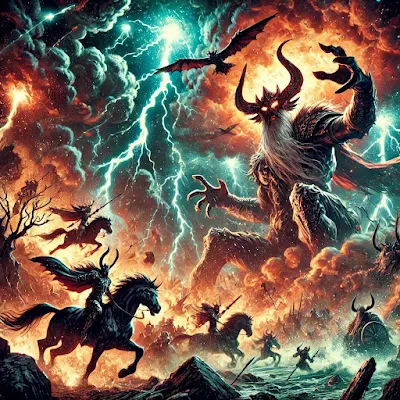
⚔️ Ragnarök: The End of the World and Loki's Revenge
An Enchanted Legend of the Norse Apocalypse, the Fall of the Gods, and the World Reborn
Enchanted Ink & Quill | Legends of Norse Mythology
🌩️ When the Gods Met Their Doom
Ragnarök. The Norse apocalypse. The grand finale of the gods, the end of the old world, and quite possibly the worst day in Asgard's entire history.
Imagine a catastrophe so enormous that the sun is swallowed, the earth trembles, ancient monsters break free, and the gods themselves march toward a battle from which many will never return.
No pressure, Odin.
The Norse called this terrible destiny Ragnarök, often translated as the fate or doom of the gods. It was no ordinary war, no petty disagreement between rival kingdoms, and certainly no family reunion anyone would willingly attend.
This was the final showdown between the gods and the forces destined to bring their world crashing down.
And among the figures caught up in this catastrophe was Loki, the trickster whose complicated history with the gods had already ended in betrayal, punishment, and a rather unpleasant arrangement involving a venomous serpent.
But was Ragnarök truly Loki's revenge?
Well, that makes a wonderfully dramatic title. The ancient myths, however, give us something more complicated than a simple revenge plot. Loki takes part in the final conflict, but the surviving sources do not establish that he orchestrates the entire apocalypse as a personal revenge scheme.
Still, considering his history with Asgard, one can hardly blame anyone for raising an eyebrow when his name appears on the guest list.
Let us begin at the end.
🐺 The Family That Made the Gods Nervous
Long before Ragnarök arrived, Loki became the father of three extraordinary children with the giantess Angrboda.
Their names would become woven into the prophecies of the gods' destruction.
First came Fenrir, the monstrous wolf whose growth and strength frightened the gods so greatly that they eventually bound him with the magical fetter Gleipnir.
Then came Jörmungandr, the Midgard Serpent, cast into the sea surrounding the world of humans. There he grew until he encircled Midgard, biting his own tail.
And then there was Hel, appointed ruler of the realm of the dead that bears her name.
What a family.
One child was destined to devour Odin. Another would battle Thor. The third ruled over the dead.
If Loki ever attended a parent-teacher conference, one can only imagine the paperwork.
Yet there is an important distinction here. The myths do not portray all three siblings as leading a united army against Asgard. Fenrir and Jörmungandr take direct roles in the final battle, while Hel's established role is that of a ruler of the dead. Her participation as a commander in Ragnarök is not clearly established in the surviving accounts.
The gods had reasons to fear Loki's offspring, but their destinies were not identical.
And the worst was yet to come.
❄️ Fimbulwinter: The World Begins to Fall Apart
Before Ragnarök, the world descends into a terrible winter known as Fimbulwinter.
According to Snorri Sturluson's Prose Edda, three consecutive winters pass without a summer between them. The cold is severe, the winds are fierce, and the world grows increasingly hostile.
But the winter itself is only part of the catastrophe.
Violence spreads among humankind. Brothers turn against brothers. Family bonds collapse, and the old rules of loyalty and kinship crumble beneath greed and conflict.
In other words, civilization begins behaving as though everyone has collectively decided that getting along is hopelessly overrated.
The prophecy describes an age of swords, axes, shattered shields, and bloodshed. The world becomes a place where trust is scarce and survival grows uncertain.
And while mortals struggle through this misery, the cosmic order itself begins to unravel.
The wolves associated with the sun and moon pursue their prey. Eventually, the sun is swallowed, plunging the world into darkness. Snorri's account also describes the moon being swallowed.
The earth shakes. Ancient bonds break. The monstrous wolf Fenrir is freed, and the Midgard Serpent rises from the sea, churning the waters and spreading venom.
The signs are unmistakable.
Ragnarök has begun.
And if anyone still thought this winter would end with a pleasant spring, they might wish to reconsider their optimism.
⛓️ Loki Breaks Free
To understand Loki's place in Ragnarök, we must return to the punishment that preceded it.
After the death of Baldr, the beloved son of Odin and Frigg, Loki was held responsible for the tragedy. He fled the gods, but they eventually captured him.
His punishment was brutal.
The gods bound him, and a venomous serpent was placed above him so that its poison would drip onto his face. His wife, Sigyn, remained beside him, catching the venom in a vessel. When she had to empty it, the poison fell upon Loki, causing him terrible agony. His violent convulsions were said to produce earthquakes.
There he remained, bound until Ragnarök.
Quite the punishment for a trickster who had spent so much time making trouble for everyone else.
But the old bonds could not hold forever.
When Ragnarök arrived, Loki was freed from his imprisonment and joined the forces opposing the gods. The Poetic Edda describes him aboard a ship associated with the approaching hosts, while Snorri's account places him among the enemies gathered for the final battle.
The ship was called Naglfar, a vessel associated with the nails of the dead.
Yes, nails.
The Norse imagination was not particularly interested in making the apocalypse pleasant to look at.
According to Snorri, Naglfar was made from the nails of dead people, which explains the old warning that the nails of the deceased should be trimmed. The idea was that untrimmed nails would contribute to the construction of this dreadful vessel.
Imagine discovering that your manicure had cosmic consequences.
One would hope the gods had a very strict nail-care policy.
As for Loki, his release marked the return of a figure whose relationship with the gods had ended in violence and betrayal. Whether revenge motivated his actions at Ragnarök remains an interpretation rather than an established fact.
Whatever his reasons, he was now part of the final catastrophe.
And Asgard had considerably bigger problems than one angry trickster.
⚔️ The Final Battle of the Gods
The forces of Ragnarök gathered for the last confrontation.
The gods prepared to fight, knowing that the prophecies foretold terrible losses. Their enemies advanced, and the great battle unfolded on the plain of Vígríðr in Snorri's account.
This was not a conflict in which everyone could expect to return home for supper.
The gods would face their destined adversaries, and the results would be devastating.
🐺 Odin and Fenrir
Odin, the All-Father, ruler of Asgard and a god who had long sought knowledge of the future, faced Fenrir, the monstrous wolf.
The outcome was terrible.
Fenrir swallowed Odin.
Yes, the chief of the gods, the one-eyed seeker of wisdom, the ruler who had sacrificed much in pursuit of knowledge, met his fate in the jaws of Loki's monstrous son.
It is difficult to imagine a more humiliating end for a god who had spent so much time preparing for the future.
But the story did not end with Odin's death.
His son Víðarr, a powerful and largely silent god, stepped forward to avenge him.
In Snorri's account, Víðarr wore a remarkable shoe and used it to brace Fenrir's lower jaw before tearing the wolf's mouth apart. The Poetic Edda presents a different detail, describing Víðarr striking the wolf through the heart.
The accounts differ in this part of the story, but the outcome is the same.
Víðarr killed Fenrir.
Odin was avenged, although the victory could not restore the All-Father to life.
One wolf down.
Several world-ending problems still remaining.
🌊 Thor and Jörmungandr
Thor, the thunder god, faced another of Loki's children: Jörmungandr, the Midgard Serpent.
Their hostility had deep roots. Thor had encountered the serpent before, including the famous fishing expedition in which he nearly pulled the enormous creature from the sea.
At Ragnarök, the two finally met in their destined confrontation.
Thor killed Jörmungandr.
But victory came at a terrible price.
The serpent's venom poisoned the thunder god, and Thor managed only nine steps after slaying his enemy before falling dead, according to Snorri's account.
Nine steps.
After everything Thor had survived, after giants, monsters, and enough dangerous adventures to fill several lifetimes, he defeated the world-serpent only to succumb to its poison.
It was a victory that could hardly be called a happy ending.
The serpent was dead. Thor was dead. And the world was still falling apart.
Someone might reasonably ask whether the gods had considered a less destructive way to settle their family disputes.
Unfortunately, the opportunity for mediation had passed.
🔥 Freyr and Surtr
Freyr, the god associated with fertility, prosperity, and peace, faced Surtr, the mighty fire giant associated with Muspell.
Freyr had once possessed a magnificent sword but had given it away. In Snorri's account, that decision left him at a disadvantage when Ragnarök arrived.
Surtr killed Freyr.
The fire giant then played his terrible part in the destruction that followed, unleashing flames that consumed the world.
For more about this particular agent of cosmic devastation, see our companion legend, Surt: The World's Slowest Burning Fuse.
Because apparently, even the apocalypse has a supporting cast.
⚔️ Loki and Heimdall
And then came the confrontation between Loki and Heimdall.
Heimdall was the watchman of the gods, the vigilant guardian associated with the rainbow bridge Bifröst. He was destined to sound the alarm when Ragnarök approached, warning the gods that the final battle had begun.
Loki, meanwhile, stood among their enemies.
Their relationship had long been marked by hostility, and their final encounter ended in mutual destruction.
Loki and Heimdall killed one another.
The trickster and the watchman, two figures whose paths had crossed in conflict, met their ends together amid the devastation of Ragnarök.
It was a fittingly grim conclusion to their rivalry.
No clever escape. No last-minute bargain. No miraculous loophole.
This time, the trickster could not talk his way out of the ending.
🌋 Surtr Sets the World Ablaze
With the great battle underway and the gods falling, the final catastrophe reached its terrible conclusion.
Surtr's flames swept across the world.
The earth burned, the heavens were consumed, and the familiar order of existence collapsed. Ragnarök was not simply the downfall of individual gods. It was the destruction of the old world itself.
The end had arrived.
And for all the wisdom of Odin, the strength of Thor, the vigilance of Heimdall, and the power of the other gods, the old order could not survive.
The world was engulfed in fire.
The gods' enemies had fulfilled their roles in the prophecy, and the age that had shaped the stories of gods and mortals came to an end.
It was a catastrophe of unimaginable scale.
Even Loki's revenge, if revenge was indeed part of his motivation, could hardly have been more complete than the destruction of the world he had once inhabited.
But the mythology leaves us with a question.
If the world has ended, what comes next?
🌱 The World Reborn
Here is where Ragnarök becomes more than a story of doom.
The surviving Norse traditions describe a renewed world emerging after the destruction. The earth rises again from the sea, becoming green and fertile. The old devastation gives way to the possibility of new life.
The catastrophe is immense, but it does not erase existence forever.
Two human survivors, Líf and Lífþrasir, endure the destruction and become the ancestors of a renewed human population in Snorri's account. Their names are commonly understood as carrying associations with life and vitality.
They represent the continuation of humanity after the old world has fallen.
And the gods do not all vanish forever, either.
Víðarr and Váli survive, as do Thor's sons Móði and Magni, who inherit their father's hammer, Mjölnir. In Snorri's account, Baldr and Höðr also return from the realm of the dead.
A new generation emerges from the devastation.
The world begins again.
This does not mean that Ragnarök is simply a cheerful tale about change being good for everyone. Its destruction is terrible, and the deaths of the gods are central to the tragedy.
But the renewed earth introduces a powerful contrast to the devastation that came before it.
The end of the old world is not necessarily the end of all things.
Even after fire and ruin, life can return.
⚜️ The Takeaway: Was Ragnarök Really Loki's Revenge?
Now we arrive at the question behind our title.
Was Ragnarök Loki's ultimate revenge against the gods?
It is an appealing interpretation. Loki had been bound and tormented after Baldr's death, and he joined the forces opposing the gods when Ragnarök arrived. He also fought Heimdall, with both meeting their deaths.
There is certainly plenty of material for a dramatic revenge story.
But the surviving Norse sources do not explicitly establish that Loki planned Ragnarök as a personal revenge scheme. The apocalypse belongs to a much larger pattern of prophecy, conflict, and cosmic destruction.
Loki's role is significant, but he is not the sole architect of the catastrophe. Fenrir, Jörmungandr, Surtr, and other forces all contribute to the final events.
The more accurate interpretation is that Loki becomes one of the figures on the opposing side in a conflict that destroys the old world. Calling it his revenge gives the legend a modern storytelling angle, not a definitive explanation of his motives in the ancient myths.
And honestly, the distinction makes the story more interesting.
Ragnarök is not merely one trickster settling a score.
It is the fate of the gods unfolding, with old rivalries, terrible prophecies, and devastating consequences coming together in the final battle.
As for Loki, his story ends alongside the world he helped trouble.
The trickster falls. The gods fall. The world burns.
And then, against all expectations, a new world rises.
Perhaps the final lesson is not that nobody should ever mess with wolves, serpents, or Loki, although that is certainly sound advice.
Perhaps it is that no age lasts forever, no power is entirely beyond fate, and even the most devastating ending can leave room for a beginning.
Ragnarök was the end of the old world, but it was not the end of the story.
And somewhere in the grand, complicated history of Norse mythology, that may be the most extraordinary twist of all.
The End.
An Enchanted Ink & Quill retelling inspired by the surviving traditions of Norse mythology, particularly the Poetic Edda and Snorri Sturluson's Prose Edda. The title's framing of Ragnarök as Loki's revenge is a creative interpretation rather than an established explanation of the ancient myth.


